What Is a Linocut Print? And Why This Brutal Technique Fits My Work
Updated: Aug 31
People often ask what exactly a linocut print is. On the surface the answer is simple: it’s a printmaking technique where an image is carved into linoleum, ink is rolled onto the surface, and the image is pressed onto paper.
But that description barely captures what the process actually feels like.
Because working with linocut is not just about printing an image. It’s about carving decisions into material in a way that can’t be reversed. Once the blade cuts into the block, that line is permanent. There is no undo button, no soft correction, no repainting. The image becomes a series of irreversible gestures.
For me, that physical commitment is exactly what makes the medium so powerful.
Essential Tools for Linocut Printmaking
Although linocut printmaking looks simple, the process relies on a few essential tools. Most artists develop their own preferred setup over time, but the basic materials remain surprisingly minimal.
The most important element is the linoleum block, the surface into which the image is carved. Traditionally this material is a dense grey linoleum that allows for precise cuts while still offering some resistance to the blade.

To carve the design, printmakers use gouges, small curved blades designed to remove material in controlled lines and shapes. High-quality carving tools are crucial here, as they determine how cleanly the lines can be cut.
Once the block is carved, printing ink is rolled across the surface using a brayer, a handheld roller that distributes the ink evenly. A sheet of paper is then placed on top of the inked block and pressure is applied to transfer the image.
Many artists also use a baren or printing press, depending on the scale of the work and the desired level of pressure. I use my full body weight instead.
How Linocut Printmaking Works – Step by Step
Linocut belongs to a family of techniques called relief printing. The principle is almost primitive in its simplicity. The artist carves away everything that should remain white. The remaining surface receives ink and transfers the image to paper.
The first step is usually drawing the composition onto the linoleum block. From there the carving begins, using sharp gouges that remove the material line by line. What disappears will never print. What remains becomes the image.

After carving, ink is rolled across the surface of the block with a roller. A sheet of paper is placed on top and pressure is applied, either by hand or with a press. When the paper is lifted, the image appears in reverse. I‘ve created a little step by step video.
It is a direct process, but it demands concentration. Every cut changes the image permanently
Why Linocuts Look so Graphic
One reason linocuts are visually so striking is that the technique forces artists to think in extremes. Instead of gradually building tones like in painting, the artist works with strong contrasts between light and shadow. Lines become structural. Shapes become bold. Details have to be reduced to what is absolutely necessary.
This reduction gives linocuts a very particular energy. The images often feel graphic, immediate and unapologetic. Historically the technique attracted artists who were interested in exactly that kind of visual clarity, including figures like Pablo Picasso and Henri Matisse, who both experimented with linocut printmaking in the twentieth century.
Why I Use Linocut for My Work
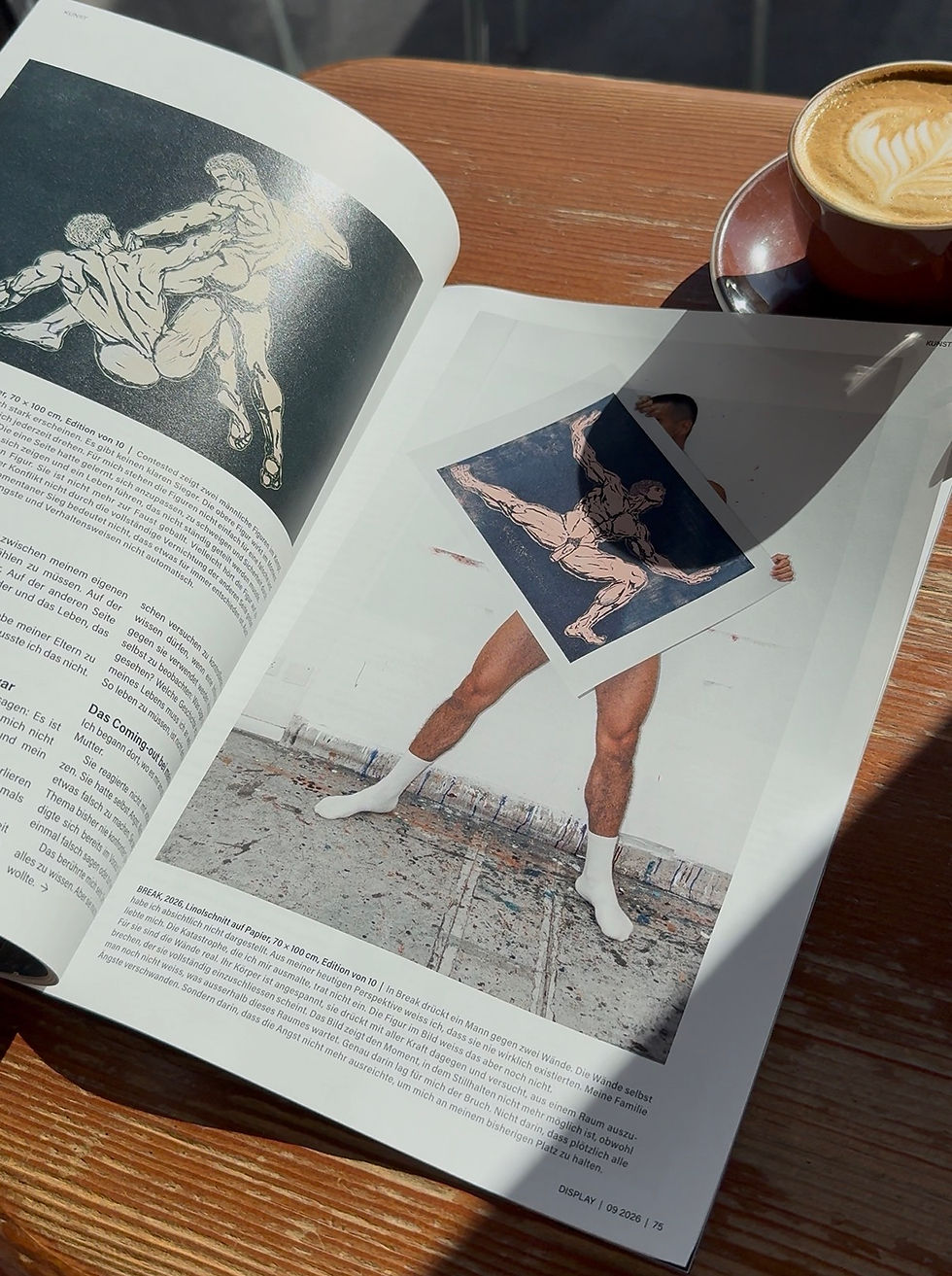
For my own work, the appeal of linocut is deeply connected to the body. My images often revolve around male figures, intimacy, tension and vulnerability. Linocut has a rawness that amplifies those themes. The carved line feels almost sculptural, like drawing directly into skin.
At the same time the technique forces a certain honesty. You cannot hide behind endless adjustments. Each cut reveals a decision. Each mark carries the physical gesture of the hand.
That intensity suits the kind of imagery I am interested in. Bodies rendered in linocut tend to look stronger, more graphic and more present. Muscles become shapes. Shadows become emotional space. The image gains a kind of directness that softer techniques rarely achieve.
In queer art especially, that visual directness can be powerful. The body is not treated as decoration but as a presence.
Reduction Linocut: Printing by Destroying the Block
Some of my works use a particularly demanding version of the technique called a reduction linocut. Instead of carving a separate block for each color, the same block is gradually carved and printed multiple times. The first layer might be a light color. After printing it, more of the block is carved away to prepare the next color. The process repeats until the final image emerges.
What makes this approach dramatic is that the block slowly disappears while the edition is printed. By the time the final color layer is finished, the original block has been largely destroyed.

Printmakers sometimes call this method a “suicide print” because once the edition is complete, the image can never be reproduced again. (Read why this technique can be so frustrating.)
Are Linocut Prints Original Art?
This is one of the most common misunderstandings about printmaking. A linocut print is not a reproduction of an artwork. It is the artwork.
Each print is created by pressing paper onto the original carved block. When artists work in limited editions, the prints are usually signed and numbered to indicate how many exist. This combination of manual production and controlled editions is what makes handmade prints collectible.
Although each impression comes from the same block, small differences in ink density, pressure and paper give every print subtle variations. These traces of the process are part of what collectors value.
Why Handmade Prints Still Matter
We live in a moment where images can be generated instantly and reproduced infinitely. Against that backdrop, traditional printmaking almost feels radical.
Linocuts carry the evidence of the process: the resistance of the material, the rhythm of the carving, the pressure applied during printing. They remind us that an image can be the result of time, risk and physical labor.
For me that tension between control and irreversibility is exactly what keeps the medium alive. Each print begins as a block of material that could easily be ruined. The image only appears because someone was willing to cut into it and accept the consequences.
And that, in a strange way, is what makes linocut such an honest form of image-making.
Discover My Linocut Prints
If you want to see how this technique translates into finished works, you can explore my current editions. All of them are printed by hand in small editions and combine traditional relief printing with contemporary queer imagery.
FAQ
What is a linocut print?
A linocut print is a relief printmaking technique where an image is carved into a sheet of linoleum. Ink is rolled onto the raised surface and transferred onto paper by applying pressure. It is one of the most direct and unforgiving printmaking methods, as every cut into the block is permanent and cannot be undone.
Is a linocut print an original artwork or a reproduction?
How many prints are in a linocut edition by ego andaluz?
What is a reduction linocut?
Why does ego andaluz use linocut for homoerotic and queer art?


Comments