A Queer Artist Reflects on the Exhibition “The First Homosexuals” at Kunstmuseum Basel — From Hidden Codes to Explicit Bodies
Updated: Mar 16
Before becoming an artist, I studied sociology. One of the first things you learn is that we never observe society from a neutral distance. We are part of the world we try to understand — shaped by its norms, language, and conflicts. Another lesson follows quickly: when we look at the past, we rarely do so innocently. We interpret it through the concepts and questions of our own time.
I was reminded of this while visiting “The First Homosexuals” at Kunstmuseum Basel.
At first, the sociologist in me took over. I found myself thinking about how identities are formed, how language creates categories, and how something as familiar today as “homosexuality” only emerged as a concept in the late nineteenth century.
But as I moved through the exhibition, another perspective returned — the artist. Instead of theories, I began to look at bodies, gestures, and images. At the subtle ways artists once suggested desire and identity when it could not yet be spoken openly.
The Birth of “Homosexuality”
For a sociologist, one moment in the exhibition immediately stands out: the moment when desire becomes an identity.
In 1869, the Hungarian writer Karl-Maria Kertbeny introduced the word “homosexual“. Gradually, something that had long existed as behaviour — men having sexual relations with men, women forming intimate relationships with women — was turned into a type of person. An identity.
The exhibition shows how unsettling this shift was. Doctors, writers, and artists struggled to understand what this new category meant. Some described homosexual men as possessing a “female soul in a male body.” Others tried to locate homosexuality in the body itself — in gestures, posture, or physical features.
Walking through the exhibition, you begin to see how these ideas entered art. Male bodies appear both powerful and strangely ambiguous — muscular, yet soft; heroic, yet vulnerable. Artists were searching for visual ways to express a new identity that society had only just begun to name.
As a sociologist, it is difficult not to notice another layer here. When we look at these works today, we already know the categories they were struggling to define. We call these artists “homosexual”, we speak of “queer history”. But the people who produced these images were navigating a world in which these identities were still unstable, contested, and deeply misunderstood.
When Desire Had to Hide
If the late nineteenth century marked the birth of “homosexuality” as a concept, it also created a paradox. Desire had been named but it could still rarely be shown openly. This is where art became crucial.
Walking through the exhibition, you begin to notice how often desire appears indirectly. Instead of explicit scenes, artists turned to mythological figures, classical bodies, and symbolic gestures. Male nudes linger in ambiguous poses; gazes between figures last just a little too long. The images seem to speak, but never quite say everything.
For artists of that time, this ambiguity was not only aesthetic. It was necessary. The social and legal context made explicit representations of same-sex desire risky, sometimes even dangerous. Mythology, allegory, and classical imagery offered a kind of visual language through which desire could appear without being openly declared.
Seen from today’s perspective, these images can feel surprisingly intimate. What once functioned as a code now reads almost transparently. The tension between concealment and expression becomes visible — a delicate balance between showing and hiding.
As I moved through the exhibition, this is where the sociologist in me slowly stepped aside. What remained was the artist, looking at bodies, gestures, and compositions, and wondering how desire finds its way into images even when it is not allowed to speak its name.
From Hidden Codes to Explicit Bodies
Standing in front of these works, I kept wondering what it means to make images of queer desire today.
The artists gathered in “The First Homosexuals“ worked in a world where visibility was fragile. Desire could appear in images, but rarely directly. It moved through mythology, allegory, and coded gestures — strategies that allowed artists to express something that could not yet be openly named.
Seen from today, these images reveal both courage and constraint.
For me as a contemporary artist, they also mark a beginning. The visual languages these artists developed — the careful ambiguities, the coded bodies — opened a space that later generations could inhabit more freely. My own work exists within that historical movement.
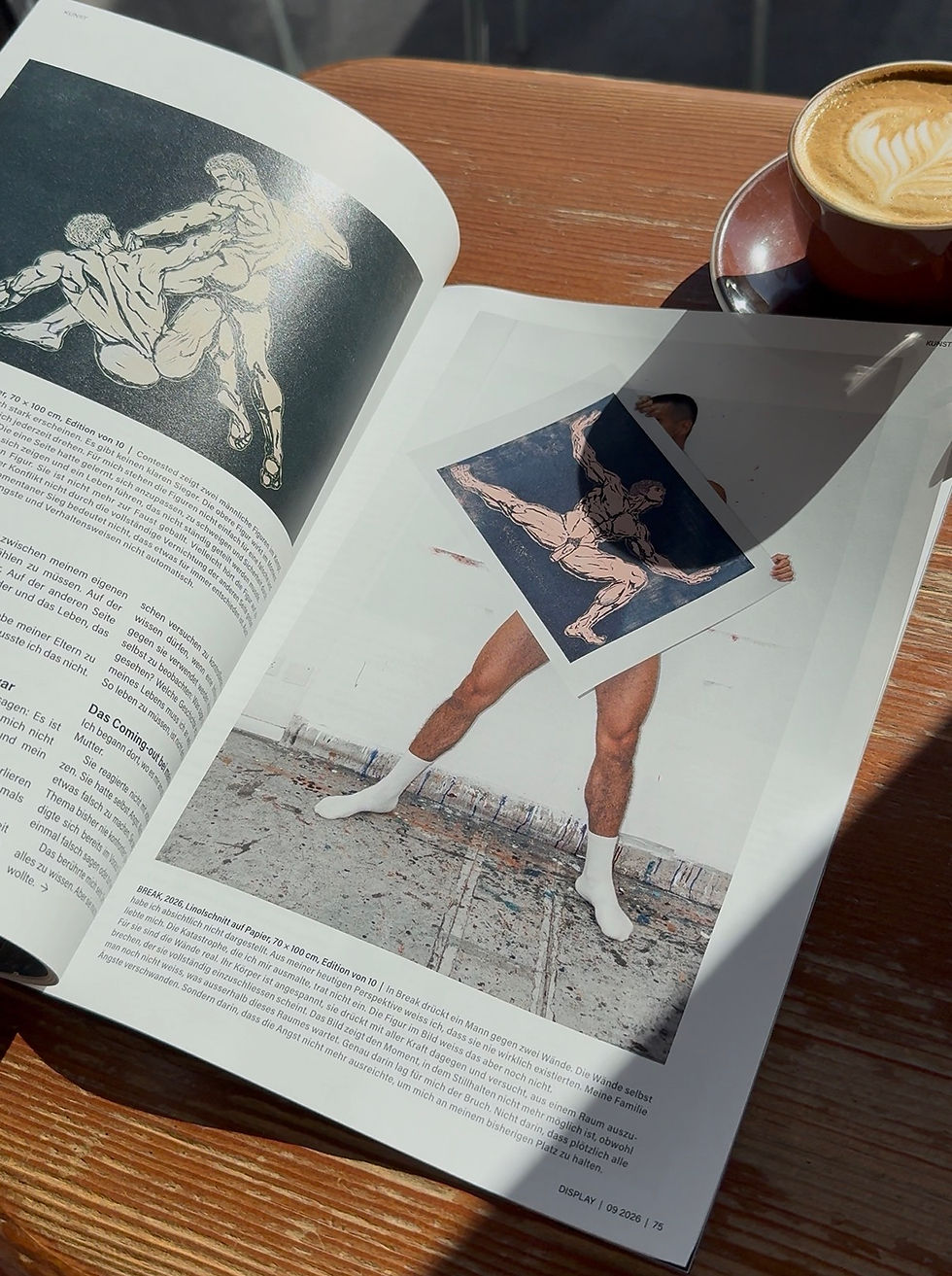
I work with linocut, a medium defined by an irreversible gesture. Once the knife enters the surface, there is no way back. The cut remains. In a way, this material logic mirrors the trajectory of queer visibility itself. The struggles of earlier generations carved a path that cannot easily be undone.
This is perhaps most visible in my reinterpretation of Narcissus. In classical representations, Narcissus discovers himself through a reflection — a mirror in water, a moment of recognition mediated by the image itself. In my version, that reflection disappears.

There is no pool, no mirror, no mythological setting that explains the scene. The figure stands alone, already aware of himself. His eyes are closed. He does not need a mirror to perceive himself fully.
The body still carries echoes of classical ideals — muscular, composed, almost sculptural. Yet the pose introduces a different reading. The gesture of the body can be interpreted in ways that Western visual culture has historically coded as feminine: softer, more open, less heroic.
What interests me here is not fixing these associations, but exposing how they work. The image allows different readings of masculinity to coexist, revealing how easily the visual language of gender can shift.
The images that once had to speak in whispers now allow for a wider range of voices — even if those voices still have the power to provoke.
Visibility Is Never Neutral
While walking through “The First Homosexuals“, it is tempting to see the story as one of progress — from silence to visibility, from coded gestures to open representation.
But history rarely moves in straight lines.
The possibility of making queer desire visible today is the result of long struggles — cultural, political, and personal. The artists shown in this exhibition were working at the beginning of that transformation, often under conditions where visibility could carry real risks. In that sense, contemporary queer artists inherit both a freedom and a responsibility.
When I first began sharing my own work publicly — with my parents, on my website, and on Instagram — I realized how difficult that step could still be. Publishing images of queer desire felt almost like a second coming out.
Visibility always invites reaction. Sometimes those reactions are supportive. Sometimes they are not. At one point, someone vandalised the window of my studio — a small but telling reminder that images of queer bodies can still provoke discomfort. Seen from that perspective, the history traced by “The First Homosexuals“ does not feel distant at all. It feels unfinished.

The artists in this exhibition often had to hide desire in myth, allegory, and coded gestures. Today, artists like myself can represent it more directly. Every act of visibility still carries the memory of those earlier struggles — and the responsibility to continue them.
Why Exhibitions Like “The First Homosexuals” at Kunstmuseum Basel Matter
Exhibitions like “The First Homosexuals“, now presented at Kunstmuseum Basel, play an important role in making our history visible.
By bringing together artworks from a moment when homosexual identity was only beginning to be named and represented, the exhibition reconstructs a cultural shift that is easy to forget today.
At the same time, the decision of institutions such as Kunstmuseum Basel to present this history in a major museum context is significant. It signals that these artworks now belong to a broader narrative of art history.
Explore the Exhibition
More information about the exhibition can be found here:
The First Homosexuals — Instagram


Comments